
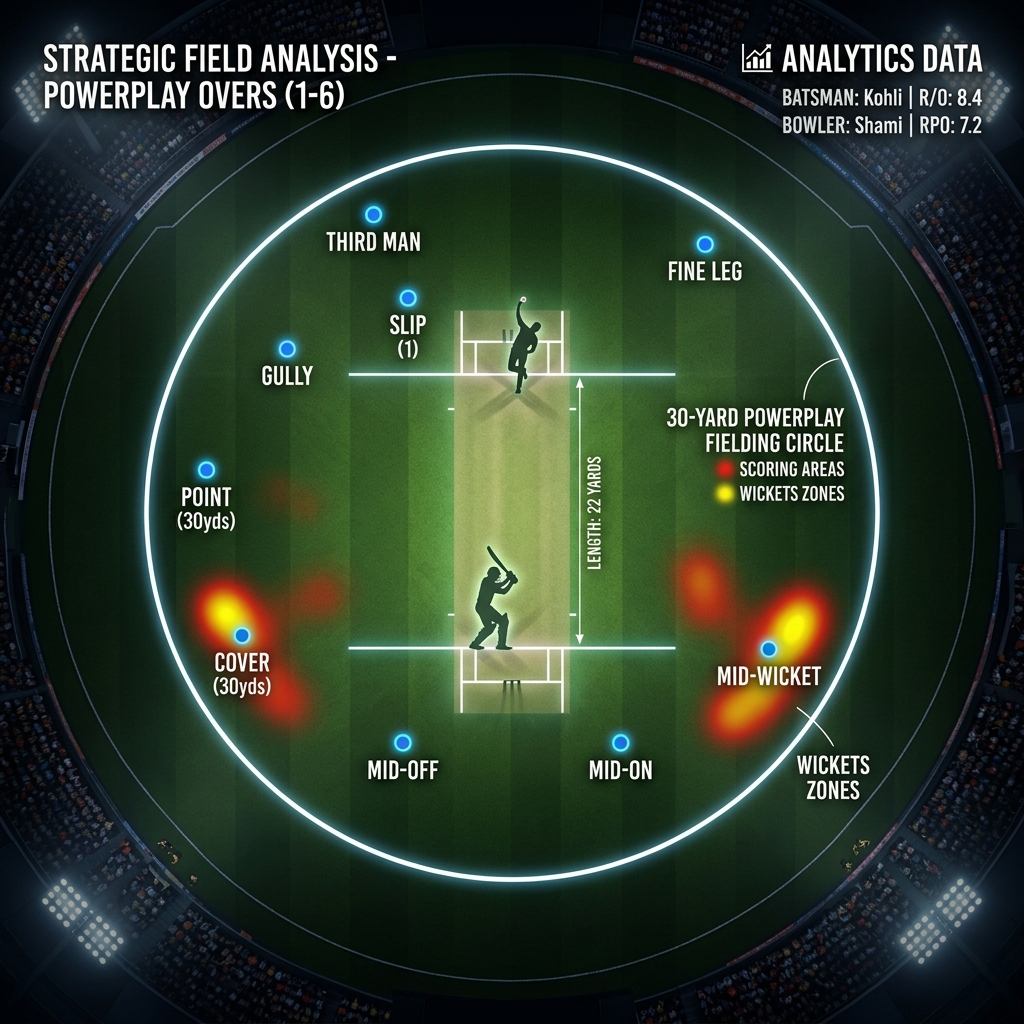
In modern limited-overs cricket, the match is frequently decided long before the final over begins. The initial Powerplay — overs 1 to 6 in T20s, overs 1 to 10 in ODIs — represents the most mathematically favorable scoring environment in the sport. With only two fielders permitted outside the 30-yard fielding circle, the geometry of run prevention is completely compromised. Teams that master Powerplay aggression establish an irreversible momentum advantage that defines the entire game.
The Mathematics of Geometric Gaps
On a standard international ground with a 70-meter boundary radius, a standard fielding layout features nine outfield catchers or boundary sweepers. In the Powerplay, seven of those nine players are legally restricted inside the 30-yard ring. For the batting team, any stroke that clears the infielders with moderate elevation is guaranteed to reach the boundary.
Ground telemetry demonstrates that an aerial shot struck at 95 km/h in the Powerplay produces a boundary 84.2% of the time, compared to just 36.4% in non-Powerplay overs where boundary sweepers are stationed at deep midwicket, long-on, and deep backward point. Recognizing this arithmetic, elite white-ball teams have completely abandoned the traditional 'look-in' phase for opening batsmen.
Correlation with Victory: The Powerplay Differential
Analyzing 1,800 international T20 matches reveals that the team leading the Powerplay score differential (runs scored in Powerplay minus runs conceded in Powerplay) wins 74.8% of matches. In ODIs, the correlation remains astonishingly strong at 69.4%.
A 20-run surplus generated in the Powerplay carries a significantly higher win probability coefficient than a 20-run surplus generated in the death overs, because an early run surge establishes strategic freedom for the middle order, forcing the opposing captain into defensive field settings and premature bowling rotations.