
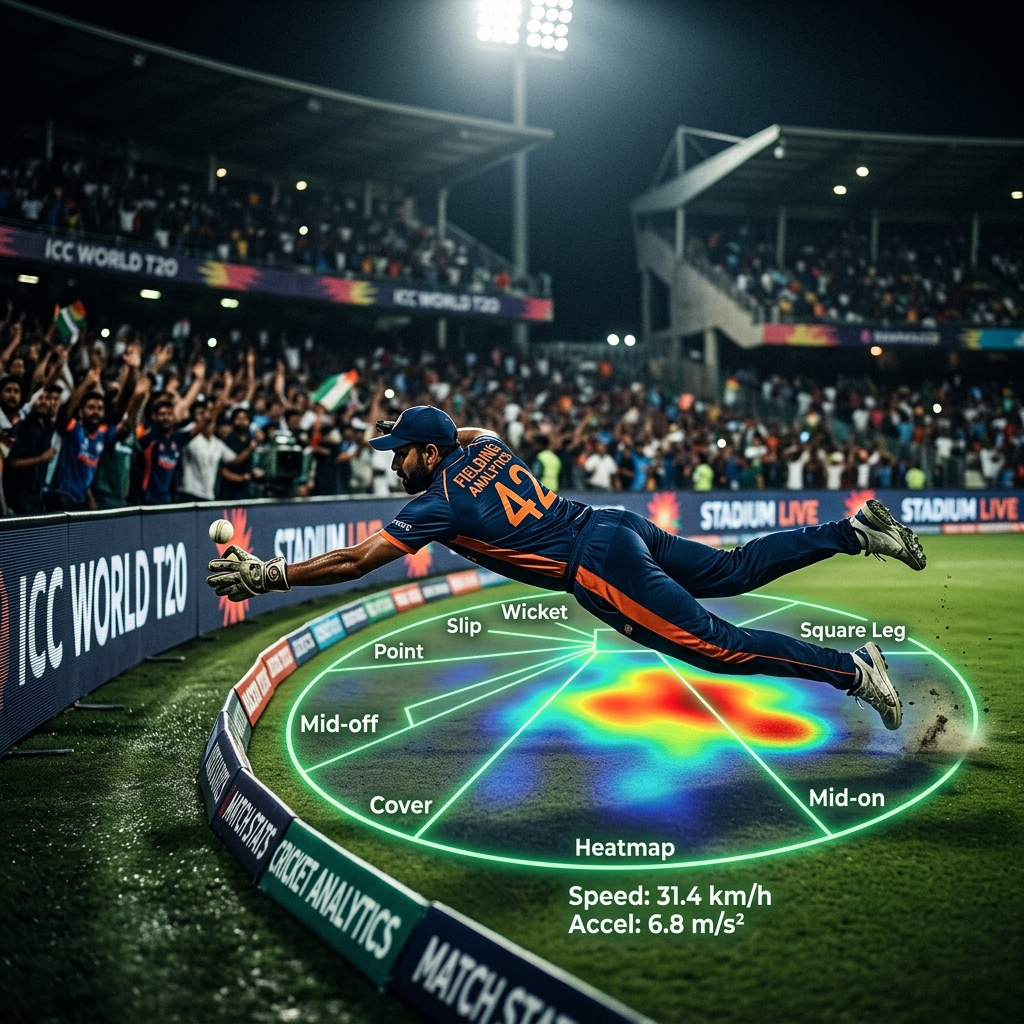
Batting and bowling analytics have dominated cricket data discussions for years. But fielding — the third pillar of cricket performance — has remained stubbornly underanalysed. That is rapidly changing. The integration of fielding metrics into broader match analysis frameworks like CricRover's BPI reveals that fielding quality contributes 8-12% of a bowler's pressure score.
Why Fielding Data Has Been Neglected
Fielding is difficult to quantify. Unlike batting (runs, strike rate) or bowling (wickets, economy), fielding outcomes are binary and rare — you either take the catch or you don't. The subtler fielding actions — saving two runs at long-on, cutting off a single to cover, positioning 5 yards wider to cover the batsman's dominant shot — have historically been invisible to standard statistical frameworks.
Boundary Prevention: The Hidden BPI Input
CricRover's BPI calculation incorporates boundary prevention data as a key input. A bowler's BPI is not calculated in isolation — it reflects the collective fielding effort around them. When a fielder saves a boundary by diving at full stretch and concedes only a single, that contributes to the bowler's BPI score. A team with excellent fielding can boost their bowlers' BPI by 5-8 points on average.
The Run-Out Dimension
Run-outs are massively undervalued in cricket analytics. In T20 cricket, a direct-hit run-out in the 17th over with the batting team needing 10 an over produces a momentum shift equivalent to a clean-bowled dismissal. The threat of run-outs forces batsmen to refuse singles they would otherwise take, effectively creating "invisible dot balls" that improve overall bowling BPI.
The Future: Full Fielding Analytics Integration
As player tracking technology becomes more accessible, CricRover aims to incorporate dedicated fielding metrics directly into match dashboards. Expect future BPI scores to carry a visible "fielding contribution" component, making it possible to see not just how well a bowler bowled, but how much their team's fielding amplified or diminished that performance.